 RCA
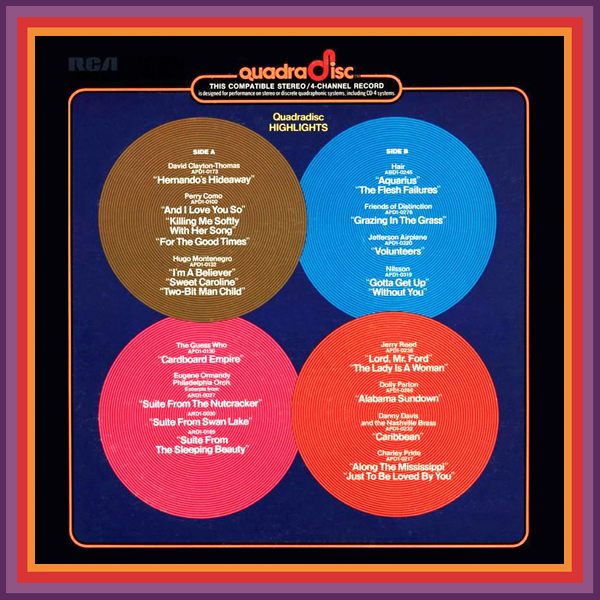
Quadradisc Highlights
Sampler
Quadraphonic LP
RCA DJD1-0072
September 1973
RCA
Quadradisc Highlights
Sampler
Quadraphonic LP
RCA DJD1-0072
September 1973
Four-channel sound, discrete or otherwise, is not new. In the early twenties, it seems that the emphasis was on volume or level, and not on recovering the acoustical environment of the recording; hence 4-channel “mono” was used to enhance playback level by a factor of four. Historical The first public demonstration of four-channel sound by RCA from magnetic tape was during the celebration of the 25th anniversary of the David Sarnoff Research Center in Princeton, New Jersey, in September 1967. The demonstration was impressive and foretold the future with greater accuracy and immediacy than was then suspected. Three years later in August, 1970, RCA introduced as a commercial product discrete 4-channel magnetic tape under the trade name Q8 and in the format of the familiar eight-track continuous loop cartridge. Previous to this, there had been several releases of discrete 4-channel sound on open reel tape. The response to the discrete 4-chgannel cartridge tape established discrete 4-channel sound as a commercial product. In October of the same year, the Victor Company of Japan introduced at the Convention of the Audio Engineering Society in New York discrete 4-channelsound from the phonograph record employing a 30-kHz fm carrier superimposed upon each of the two groove walls. A Commercial Product In September, 1971, RCA Committed to discrete 4-channel sound from records and made initial releases in May, 1972, under the trade name Quadradisc. In February, 1973, the performance capabilities of the disc can be given as a playtime of 25 to 30 minutes, a level of 3 dB above the standard reference, 55 dB signal-to-noise ratio, and with essentially the same freedom from distortion as a standard stereo record. In fact, its level or loudness is equal to the average of those stereo LP records listed on the charts as best sellers, and its technical performance as a stereo record is better. Technical progress has continued since the original introduction but the system constants have remained fixed. For stereo play, the discrete 4-channel disc looks like and plays as it were a regular stereo record. Discrete 4-channel record Four channels in one grooveWhen examined visually without the aid of optical instruments, the discrete 4-channel record groove appears to be the same as a stereo groove but under the scanning electron beam microscope, great differences are seen. Each of the two walls carry two channels of information; namely, the sum of the combination of the front and rear signals from each side of the corresponding wall of the groove in regular stereo fashion. In addition to this, a frequency modulated carrier at 30 kHz is superimposed upon each of the two stereo channels. These fm carriers provide for the recording of the difference of the front and rear signals from each side on the corresponding wall of the groove. Each wall of the groove now carries two sets of signals: the sum of the front and rear signals on the stereo base band and the difference of the front and rear signals on the carrier band. Basically speaking, this is an interference-free arrangement because the carrier signals are super-audible to the carrier signals and the stereo signals are sub-audible to the carrier signals. This is possible because of the advances of modern technology in record manufacture, pickup cartridge development, and in electronic signal processing. Compatibility with stereo The discrete 4-channel record is recorded to give full compatibility with existing stereo players. To accomplish this compatibility, all of the stereo signal is recorded in the stereo groove of the record. This means that the left front and the left rear signals added together are recorded as the left signal on the inner groove wall. The same is true of the right signals on the outer wall. When a discrete 4-channel record is played in stereo, the complete recorded signal is reproduced. This provides complete stereo signal compatibility. The left difference signal {LF – LR} is used to modulate the fm carrier recorded on the inner groove wall of the record. On reproduction, , this difference signal (LF – LR) is added to the sum signal (LF + LR) to give an algebraic result 2LR, suitably attenuated, is reproduced by the left rear speaker. The two right channels on the outer groove wall are similarly reproduced. The basic reproduction of each of the four signals is exactly the same, with the exception that the left channel tends to be, as it is in stereo, the favorite. Playback The discrete 4-channel record adds more than one new dimension on playback. Stereophonic sound added a new dimension to monophonic sound. A wall of sound replaced the single speaker. Discrete 4-channel adds three more walls and all of the included space. The objective is to be able to reproduce the entire acoustical environment of the recording as it was at the time the recording was made or as it is wanted at the time that the recording is “produced”; that is, at the time that the original recordings are mixed down from the multi-channel original recordings to the 4-channel release master tape. The listener in his home finds that there is a wide area in which he can enjoy the reproduction. In fact, he soon realizes he can hear it advantageously from any place in the room as he could have heard it from the corresponding spot in the studio if he had been there at the time the recording was made. The preferred listening area is relatively large; particularly when compared to that for 2-channel stereo. When stereophonic records are reproduced on a discrete 4-channel system, the two left and the two right speakers are paralleled, and four speaker stereo sound is enjoyed. Excerpts from a technical paper Written by Warren Rex Isom —1973 Chief Engineer of RCAs Record Division, from 1966 — 1976. 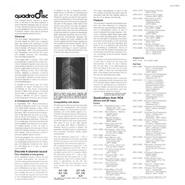
|