|
Stereophonic sound on records is finally here. It will be widely
discussed, widely written about, and, perhaps, widely misunderstood.
It cannot help but be; it is a complex achievement as well as an
extraordinary one. We offer the following primer on the subject with
the hope that it will both help you in understanding how and why
stereo works and enhance the hours of listening pleasure stereo will
offer in your home. Before stereo recording techniques were developed, the impulses of
music were picked up by only one microphone.
These impulses were then fed to one tape and
from there to the conventional, monaural record,
which you heard in your living-room through one loudspeaker.
The conventional record offered brilliant sound and exciting sound,
but, of necessity, it also offered only one-dimensional sound.
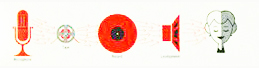
Now, the simple and obvious fact remains that we all have two ears,
and we are used to hearing things dimensionally. Generally speaking,
your left ear has a tendency to hear what goes on in the left side
of a room, your right ear, what goes on in the right side of the
room. Your brain then does two jobs. It combines both the impression
received by the left ear and that received by the right ear into one
total impression which we call music. At the same time, it retains
the spatial or dimensional impression, music to the left and music
to the right.
Let’s compare hearing to seeing for a moment. You see images on your
left with your left eye, images on the right with your right eye.
Yet, because your brain can do two jobs at one, you get a total
unified picture in its true perspective.
Stereo sound is simply the attempt to give you music as it is heard
by both ears.
Essentially, what happens is that two microphones, left and right,
pick up what goes on in the orchestra at the recording session.
These two microphones feed the musical impulses to two soundtracks
on tape. The two soundtracks are then pressed into the grooves on a
stereo record.

The sound from a record
partly depends upon how the needle moves or vibrates. For example,
when Edison designed his phonograph to play cylindrical records, he
made
 

|
the needle vibrate up and down. This is
called the “hill and dale” system, or vertical cutting.
On a conventional, monaural record, however, the needle moves from
side to side, or laterally. The lateral movement has been used ever
since the flat record replaced Edison’s cylinder.
What about the stereo record? Each groove on a stereo record has two
soundtracks cut into it, and they are cut into it both laterally and
vertically. In order to pick up the two soundtracks, a stereo needle
capable of moving complexly has been developed; it vibrates both
laterally and up and down. Simultaneously, the lateral movement
picks up one channel of recorded sound, the vertical movement the
other.
The two channels of sound picked up by the needle are then
unscrambled by the stereo cartridge. The cartridge directs them
into separate amplifier circuits, where they are magnified and
fed in turn into two separate loudspeakers. The two speakers
finally translate the musical impulses into intelligible sound
which you hear in your living-room stereophonically.
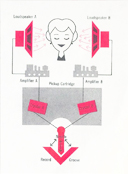
The net of it is an overlapping and blending which gives music a
more natural, more dimensional sound. For the first time, your ears
will be able to distinguish where each instrument and voice comes
from-left, right or center. In short, enveloping in solid sound, you
will hear music in truer perspective.
Stereophonic sound is the latest step in an improvement process that
began about 80 years ago. In listening to it, you will enjoy the
highest achievement yet in the art of recording.
|
When you "go Stereo"
— either by acquiring a new
stereo phonograph, or by converting your present set — your
library of "monaural" recordings does not become obsolete. Quite the
contrary — stereo reproducing equipment brings out the best in
any recording, monaural or stereo.
RCA Victor now offers an already
large — and rapidly growing
— selection of the music you want, performed by the world's greatest
artists, on LIVING STEREO long play records. |

|
| Site Links | All Albums | All Songs | The Recording Sessions |


